
Delivery insights
Stop duct-taping releases. Start a predictable delivery ritual.
How we keep scope, quality, and leadership habits aligned so shipping stops feeling like a crisis.
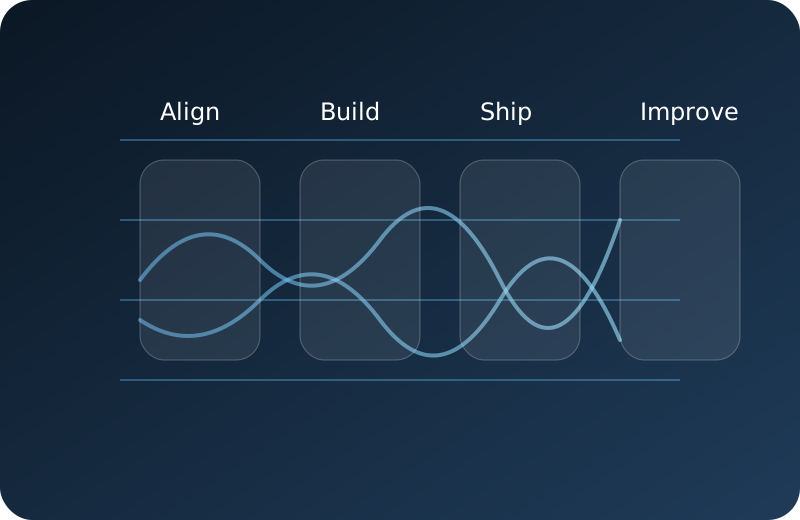
Releases shouldn’t feel like a last-minute scramble of heroics. When shipping is stressful it’s because the delivery system is inconsistent, not because the team can’t build. That’s why we orchestrate the Align → Build → Ship → Improve ritual and repeat it relentlessly.
Duct-taping releases looks like requirements arriving in Slack DMs, QA happening “if we have time,” deploy-day freezes, and painful rollbacks. Everything is unpredictable not because of tools but because leadership lets chaos persist.
The real problem: shipping without a system
- Requirements arrive in Slack DMs, half-formed and changing daily.
- QA happens “if we have time.”
- Deploy day triggers a freeze, then a mini crisis.
- Rollbacks are scary because nobody trusts what’s in the release.
- Everyone is busy, but progress is unpredictable.
The ritual in practice
- Align: write the scope, integrations, in/out-of-scope, constraints, acceptance criteria, and metrics before coding starts.
- Build: mergeable PRs in hours, trunk-based flow, feature flags, and tests that gate merges. Every change answers “what does it change?”, “how do we verify?”, “what could break?”, and “how do we roll it back?”.
- Ship: automated pipelines for every merge, immutable artifacts promoted across environments, progressive delivery (canary/blue-green), and rollbacks that are buttons, not meetings.
- Improve: weekly 30–45 minute calibration that walks through expectation vs reality, the smallest fix, and the owner who ships it.
Alignment is a single page: scope, integrations, constraints, acceptance criteria (e.g., checkout < 3 minutes, payment succeeds for Visa/Mastercard with safe failure, purchase_completed event emits order_id plus value/currency), and a few metrics that prove you’re winning (lead time, deployment frequency, change failure rate, p95 latency, conversion, support tickets).
Build keeps the ritual honest. Good PRs explain what changed, how to verify it, what it might break, and how to disable it. The CI enforces lint, formatting, tests, build, and security scans. Feature flags tame incomplete work.
Shipping becomes boring when automation runs on every merge, observability is live before ramp completes, and the release plan includes progressive delivery plus rollback plans.
Build checklist
- What does it change?
- How do we verify it works?
- What could it break?
- How do we roll it back or disable it?
Improve is calibration, not blame. Pick a smooth deploy, a painful one, or a near miss, and answer: what was expected, what happened, what’s the smallest change, who owns it, and when will it ship?
CI/CD backbone
- On every PR: lint, formatting, unit tests, build/type checks, security scans, and an optional preview environment.
- On merge to main: build once, run integration/smoke tests, deploy to staging, then production (automatic if thresholds pass or manual gate for risky changes).
- Post-deploy: automated smoke checks, error budgets, deployment annotations in logs/traces.
The “no broken production” rule keeps cadence ruthless: pipeline red? Stop and fix it. Production degraded? Pause shipping. Scope threatens quality? Scope flexes, standards don’t.
Make the ritual non-negotiable, reward calm deployments, treat scope as the variable, protect maker time, and surface every change in one source of truth.
Contact
Ready to build your next product?
We deliver front-to-cloud, pragmatic, and accountable. Tell us what you’re shipping next.